Wednesday, October 10, 2007

Morimoto & Me

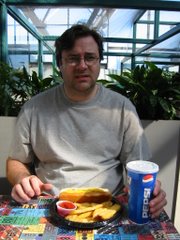
What do Morimoto and I have in common? We are in this picture together:


And that's about it.

Prior to today, I have cooked sushi a couple of times. It turned pretty well. At least I enjoyed it. In retrospect, I'm pretty sure I probably did most things wrong, like how I sliced the fish, for example.

Today we had the opportunity to work with one of the original Iron Chefs himself, Masaharu Morimoto. Morimoto has a new book and he did a demo at BU in the evening of recipes from the book.

I think the day started with people in the class feeling a little bit anxious, wondering what chef Masaharu was going to be like and how it would be working with one of the new breed of celebrity chefs. This was augmented a bit by the entourage of people who arrived with chef Masaharu (assistant chefs, promotional people and even some press).

But, I think chef Masaharu put people at ease pretty quickly. He was calm and demonstrated a quick sense of humor, despite the fact that English is not his primary language. (I always think humor is one of the more difficult things to translate across cultures and languages. And yet, laughing together is one of the quickest ways for people to bond.)

We quickly got to work, as there was quite a bit of prep work to be done for the evening's demonstration. We started with chef Masaharu demonstrating how to slice fish for sushi. I think most of us were in awe of his skills and technique. I know I was.

First off, I had knife envy. It is no secret that I have something of a knife fetish, I admit it. I also tend to prefer Japanese knives for their feel: they're balanced differently and they tend to be lighter than German or French knives. Chef Masaharu had a beautiful Japanese Yanagi-ba knife with handles made from deer antlers. This style of knife is unique to Japanese knives and features a very long and thin, but very sturdy blade. Additionally, unlike European style knives, the blade is only beveled on one side (or at least one side is beveled considerably more than the other). This knife if ideal for making precise and clean slices of fish for sushi and sashimi.

Second, to state the obvious, his technique was masterful. Each slice of the knife blade was as precise as the previous one and each slice of fish was precisely the same size and thickness as the previous one. This seems simple, but let me tell it is not. Moreover, the slices of fish were extremely thin. To produce this not only requires the correct technique but also requires a very sharp knife. If either of these things is lacking, you end up hacking the fish rather then slicing it. This is bad.

When it became our turn, I struggled with slicing the fish. After a couple of hacks, one of chef Masaharu's assistant chefs demonstrated the technique for me again. Seeing him do it while describing it made me realize why I was having such a hard time getting the technique down. It was almost exactly opposite of how I am used to slicing food. Let me explain.

Say I want to slice a carrot or a chicken breast. I will lay the tip end of the knife on the far right side of the item with the tip titled down towards the cutting board, and then push the knife forward and down, away from my body, to slice through the food. Additionally, my off hand will serve to hold the item in place while I slice off the end. Or put another way, my off hand is holding the item being sliced rather than the piece of food I just sliced off. The slices of food "come out" to the right on the other side of the knife from my off hand.

When slicing fish for sushi, the technique is almost completely reversed.

First, to slice the fish you lay the butt end of the knife on the fillet with the tip of the knife tilted up and away from you. You then pull the knife towards you and down, in a sort of semi-circular motion. In this way, the tip of the knife is the last part of the knife to pass through the food. Second, rather than using your off hand to hold the fish fillet as you slice pieces off of it, you use it to secure the newly formed slice of fish. So, instead of slices of fish coming off of the knife to the right (as with the carrot), they come off of the knife to left, into your off hand (presuming you are right handed).

Once I realized this, my slices did improve. But, quite frankly, I still wasn't very good at it. Somehow it felt unnatural to me, even though I could clearly see that this method produces beautiful pieces of sashimi. This is definitely an area that I can work on and improve.

I have to say, there are certain foods which I will happily pay another person to prepare for me, Sushi is one of those foods.

As I mentioned above, the day ended with chef Masaharu doing a demonstration for a group of about 70 or so people. The dishes he made were definitely not your traditional Japanese cuisine. There is no other way to describe what he did in terms other than to say it was "fusion." And, not just any fusion, but in this case, a fusion of Japanese and Italian cuisines. I know, that sounds like an odd pairing, but here is what he made.

First was Daikon Fettucine with a tomato-basil sauce. Here the noodles were not made from a dough, but from stripes of daikon radishes and were sauced with a very traditional Italian tomato sauce.

He also made a crispy tuna sashimi pizza and then finished the demo off with sugared salmon.

All in all, it was a good day and an interesting menu.

Saturday, September 29, 2007

Day Ten: Garnish


What we Did
: Played With Our Food (Some Would Call It Garnish).

Garnish is all about looks. But, if indeed we do eat with our eyes, then garnish has a roll to play in our world of culinary delights.

Of course, I am not sure that making a zucchini look like a flower makes me more hungry. As Jean-Jacques Paimblanc said, "less is better." That is all I am going to say on that topic.

If my attempts today are an accurate reflection of my skills in the field, I will not being doing much garnishing in the future. I am not sad about this.

In the afternoon we shared four hours with the health inspector. And, well, the less said about this the better.

Quote of the Day: "Think like the vermin!" (On what your approach should be in tackling the problem of pests in the commercial kitchen.)

Day Nine: My Hard Head and Fat

It sucks being sick. It feels like my head is full of cement.

So, since I am home sick I have been catching up on some reading. I am in the process of reading two books: Eat Fat by Richard Klein and Good Calories, Bad Calories by Gary Taubes.

Fascinating stuff, I highly recommend both books.

Each takes on, what can only be described as, the current obsession (both good and bad) with fat in this country. Klein's book is more of a philosophical venture, ruminating on the social and historical meanings of fat.

Taubes' book, on the other hand, takes on the actual science behind the current thinking about fat (dietary and bodily) and its relation to heart disease. Taubes effectively refutes the current (and seemingly irrefutable) thinking that high dietary fat is linked to heart disease and the commonly accepted rise in obesity. It is really eye opening. The fact is that the data is simply not there to support the politically and culturally accepted idea that dietary fat is bad. At least, any reasonable mind looking at the data can only conclude one thing: the evidence, taken in its totality, is inconclusive.

Moreover, he argues that the low fat/high carb diet may be doing more harm than good and may be what is really behind the rise in obesity and diabetes. The real dietary evil? The "the whites." That is, refined carbohydrates such as white sugar, white flour and white rice.

The fact is, as much we would like to think that we are rational beings, we are more likely prone to illogical thought. We all too often simply believe what we want to believe no matter what the data might tell us.

So, the question becomes, if the data is, at best, inconclusive to support the conclusion that dietary fat is directly linked to heart disease and other illnesses such as diabetes, why has this idea taken such a firm hold on our beliefs?

I can only come to one conclusion: we have a deep seeded culturally ingrained need to see fat (in all of its forms including dietary and bodily) as bad. We want to believe that fat is bad, so we make it so. We seem to have a perverse relationship with fat. We love it and we hate it. Fat has become our dietary bĂȘte noire and our fall guy. And yet, we love it as well.

Eat fat, indeed.

Thursday, September 20, 2007

Day Eight: Stewing & Braising


What we did: Braised and Stewed (but not in our own juices).

Today was the first day we worked with Jean-Jacques Paimblanc and we made four dished designed to teach us about cooking with liquid. They were, Beef Daube, Lamb Curry, Ratatouille, and Braised Endive. The essential difference between stewing and braising is that with a stew, the ingredients are entirely covered with liquid. With a braise, liquid (water, stock, wine) is present, but does not cover the ingredients. In some cases, a braise may only use steam. So, if you cover beef with enough wine and then slowly reduce the liquid to cook the meat and thicken the liquid, you are producing a stew. If, on the the other hand, you brown some endive halves, then add a small bit of liquid to the pan, cover it and then put it in the oven for 30 minutes, you are braising the endive.

Today was humbling for me. We were given the option of adding poached eggs to our ratatouille. Which we did and I was charged with this task. I have poached maybe a 100 eggs in my lifetime. It is definitely something I feel like I can do with sure success. Not this time. Not only did I not put enough vinegar in the poaching water (it helps to keep the whites from dispersing), but without me realizing it, the flame under to pot went out. So, when I went to put the eggs in the water, it was cold and not acidic enough and the result was a cloudy mess. Sigh. I had too start over.

It just goes to show, when it comes to food and cooking, you can't take anything for granted. Maybe this is why I enjoy cooking so much, it is a continual challenge and there is always something new to be learned.

All ended well though, as you can see, and I guess that is what is most important.

Quote of the day: "Cooking is being able to control the fire. Master the fire." - jj paimblanc

Tuesday, September 18, 2007

Day Seven: Grillin' & Roastin'

What we did: Grilling and Roasting

Today we cooked a lot of meat (as you can see to the left there). The idea behind today's lesson was two-fold. First, we learned about grilling and roasting foods. And second, we had the experience of what it is like to be a line chef in a restaurant.

Our charge was the following:

First, prepare the foods for the grill (cut them, trim them, flatten them, season them and so forth).

Then, we had to grill a steak, a hamburger, a salmon steak and a chicken breast while roasting a piece of flounder and a tomato. Oh, and the hamburger bun needed to be toasted. All of the foods had to be ready at the same time, as if they were ordered by one table.

We have been told again and again that cooking is about managing heat and at no time was this truer than today. Timing and judgment were the order of the day: when do should I start the chicken breast? Is the steak done enough? Should I rotate it or flip it over? Is the flame under the salmon too high? Why is the tomato burning in spots? Etc.

Know your food and know your equipment. Manage the heat!

The best part was, after we were done, we got to eat what we cooked. Mmmm, steak!

Coolest Thing I Learned Today: The system for classifying meat in the US.

The meat we eat in America is graded based on its quality (marbling, tenderness, age, ratio of fat to meat, grain, etc). I think most of us have heard terms like, prime, choice and select. But I'm not sure these terms mean much to most of us. So, here is the breakdown:

Prime is the top of the line. It should be tender and nicely marbled. Only about 2-5% of the meat produced is classified as prime. This means that you and I almost never see prime beef unless we can get it at a top restaurant. Even then, we are going to pay a steep price for it.

Choice is the next classification and constitutes the largest percentage of consumer meat (around 35%). Most of the meat we buy in fancier markets and most of the meat we are served at better restaurants is choice. There is such a thing as "hand-picked" choice which can be just as good prime. But how can this be? Well, it seems that on any given day, only a certain percentage of the meat processes at any one facility can be labeled prime. So, even if seven percent of the meat is of prime quality, only five percent of it gets labeled as such. The rest is labeled as choice. But, a good purveyor of meat will often "hand-pick" the best of the choice and give it to his/her best customers. Be nice to your butcher.

Select is the next classification and is the grade of meat found at most grocery stores and fast food joints.

Standard is the next grade and is mainly used as institutional food (yes this what they are feeding to our prisoners and our kids and grandparents.)

Then comes a grade called Canner which is used in canned meats and the like. Mmmm, Spam.

The final classification is called Cutter, but is not for human consumption, instead we feed it to Fido and Mittens.

Day Six: A Day at the Vineyard

What We Did: Learned About Food Safety and Visited A Vineyard

In the morning we learned about food safety. This is an important topic, but probably not the most scintilating reading for a Blog. At least know this: wash your hands a lot and don't cross contaminate. Oh, and time and temperature are not your friends.

In the afternoon we visited the Turtle Creek Winery in Lincoln, Mass. They are a small winery (most of the work is done by two people) that has only been in the wine business for eight years.

We took a tour of their vineyards and the wine making facility and then we tasted some of their wines. It was actually very interesting to hear them talk about what they have learned and what both their successes and failures have been. Growing wine grapes in the northeastern US is certainly a challenge because of the weather (a short growing season with a harsh winter). But, it sounded like they are pretty passionate about it and enjoy the challenge.

Quote of the day: "To make sense more common." (Stated goal of the food safety session.)

Monday, September 17, 2007

Day Five: Butchering

Today's topic is butchering.

In the morning we visited Kinnealey's Quality Meats. I won't go into too much detail here, but man there was a lot of meat and it was cold (they work in 38 degrees to preserve the meat). In many regards it was comforting, the place was clean and very well regulated.

In the afternoon we did butchering with Charles Grandon, who is the Executive Chef at the Winchester Country Club. We cut up a whole lamb, and we worked with a primal beef rib section and some chickens.

As a devout carnivore, I have worked with a lot of meat in my life, but I have never butchered a whole animal before. I must say it was at once informative, exciting and a little off-putting. But, not enough of the latter to make me stop eating or even working with meat. It was simply a new experience. I tried going vegetarian once in my life after seeing a whole pig on a spit and I lasted all of a week. Nope, I am a meat eater.

The most interesting part of it all for me was seeing just how difficult and complex it is to cut up an animal for consumption. Our juicy little steaks come all neatly prepared and ready to cook, but it takes a lot of work and skill to breakdown and fabricate all of that meat. Moreover, it takes a lot of skill to know where to cut and where not to cut, and what to trim and even if you can see what needs to be trimmed, it doesn't mean that you can easily figure out how to do it. I have a lot more appreciation for the work that butchers do.

So, thanks. Because I don't know what I would do without my Sunday night grilled steak. Which I do even in the dead of winter.